Why your winter fodder choice matters
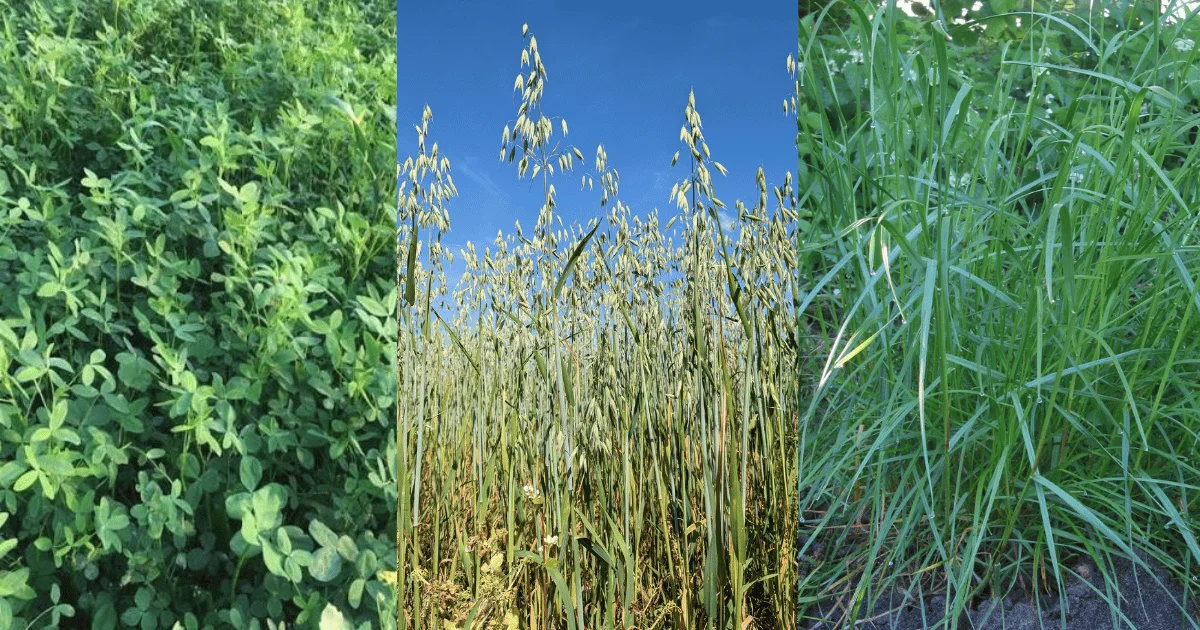
For most dairy farmers in Pakistan, the best rabi fodder is not one crop but the right mix: berseem for protein, oats (javi) for bulk and silage, and ryegrass for long, steady cuts. The right choice depends on your canal or tubewell water, soil, herd size, and whether you plan to preserve surplus.
Pakistan’s buffaloes and cows depend almost entirely on cultivated green fodder, because the country has no proper pastures for dairy animals. Yet fodder area keeps shrinking as farmers shift to cash crops, and many end up feeding wheat straw (toori) or buying expensive fodder from the market. Twice a year, in May–June and again in October–November, green fodder runs short and milk yields drop.
A good rabi fodder plan does two jobs. It keeps animals milking from December to April, and it produces surplus you can turn into silage or haylage for the lean months. This guide compares berseem, oats and ryegrass side by side for Pakistani conditions.
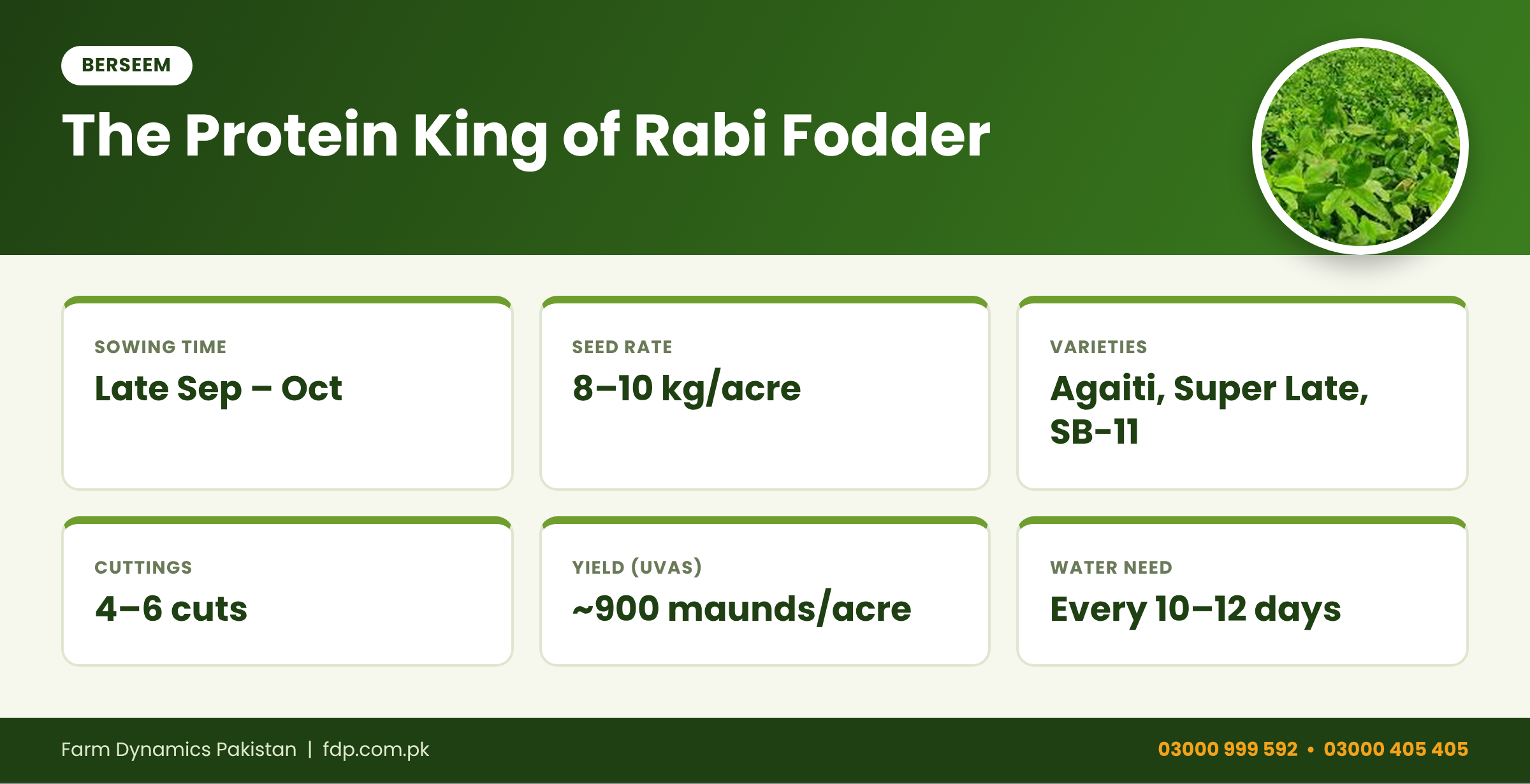
Berseem: the protein king of rabi fodder
Berseem is Pakistan’s largest rabi fodder crop, and Punjab grows almost all of it. A Dawn report put Punjab’s share at about 88% of the national area, with Sindh at 9%.
- Sowing time: late September to October. Late sowing usually costs one or two cuttings.
- Seed rate: about 8–10 kg per acre. Pakistani farmers traditionally broadcast it into standing water (the kacha method), and research from Pakistan found broadcasting gave about 44% more fodder than sowing in 30 cm rows. Where berseem is grown for the first time, treat seed with Rhizobium culture.
- Varieties: popular Pakistani varieties include Agaiti Berseem, Super Late and Punjab Berseem (SB-11). Agaiti gives early cuts; Super Late keeps producing longer into spring.
- Cuttings and yield: first cut roughly 50 days after sowing, then every 25–30 days. Farmers typically take 4–6 cuts through March or April. UVAS puts the average 4-cut yield at about 36 tons per acre (around 900 maunds), with 48 tons achievable under good management.
- Water: Berseem seeds are thirsty, needing irrigation roughly every 10–12 days. That is hard on tail-end canal farms and expensive with diesel tubewells.
Strengths
- Very high protein and highly palatable, so it can cut khal and concentrate costs.
- A legume that fixes nitrogen and leaves the soil richer for cotton, rice or maize.
- Many cuts from one sowing.
Weaknesses
- Growth slows sharply in December–January cold and foggy weather.
- Fed alone, it can cause bloat (aphara); mix it with a grass fodder or toori.
- High moisture makes it hard to make silage from berseem alone.
- Seed sold in local markets is often mixed with kasni and other weed seed, so buy certified berseem seed from a trusted supplier.
Oats (javi): the bulk and silage crop
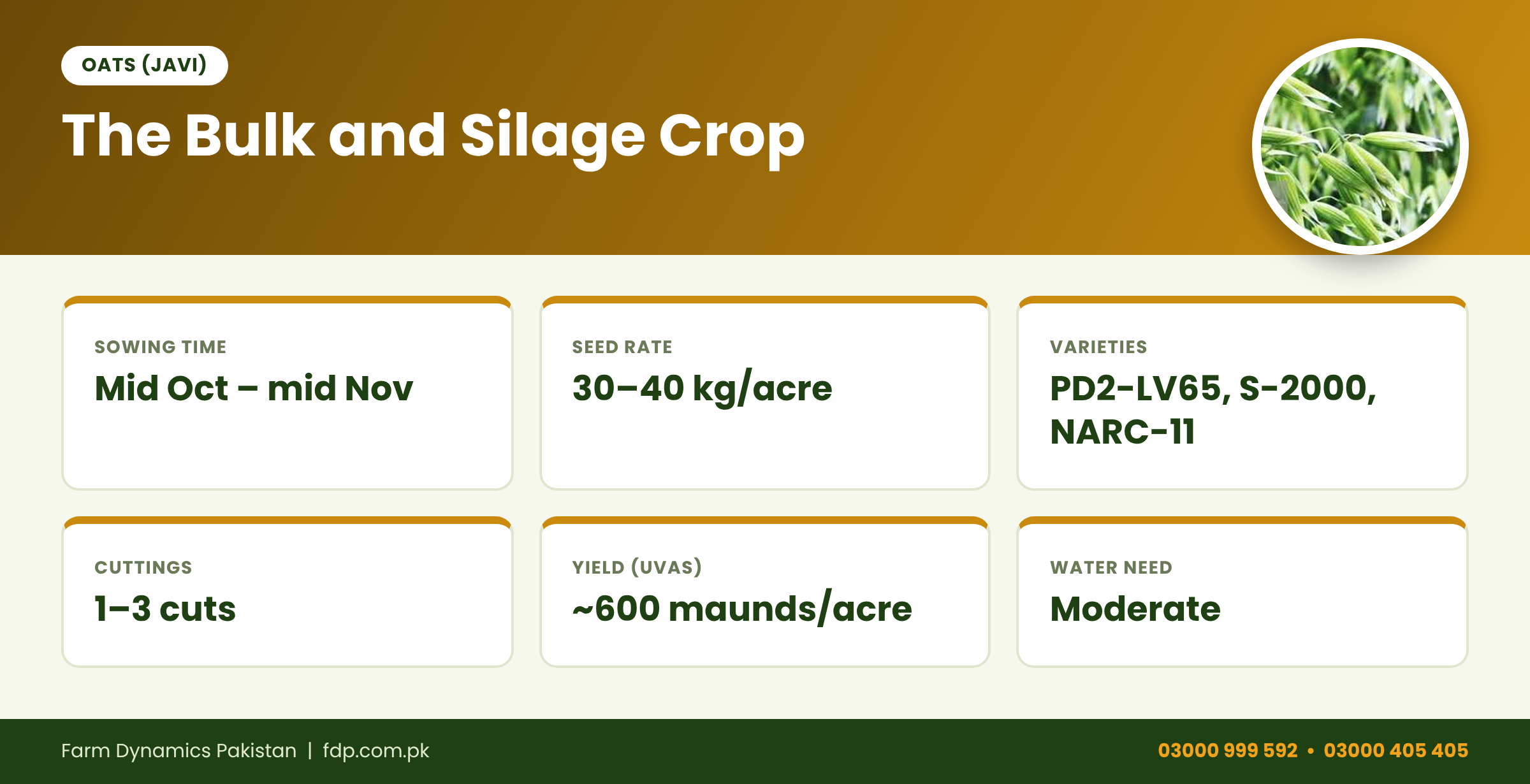
Oats give a lot of green matter fast, handle cold and fog well, and are the easiest of the three to turn into silage.
- Sowing time: mid-October to mid-November. Oats forgive late sowing better than berseem, so they suit fields vacated late from rice in Gujranwala and Sheikhupura, cotton in south Punjab, or sugarcane.
- Seed rate: about 30–40 kg per acre. Drilling in rows gives a better stand than broadcasting.
- Varieties: improved forage varieties approved by the Punjab Seed Council include PD2-LV65, S-2000 and NARC-11. Choose single-cut types for maximum silage tonnage, and multi-cut types if you want two or three green cuts.
- Cuttings and yield: usually 1–3 cuts. UVAS puts the average 2-cut yield at about 24 tons per acre (around 600 maunds), with 30 tons achievable.
- Water: moderate. Oats need fewer irrigations than berseem and also do well in barani (rainfed) areas like the Potohar.
Strengths
- High tonnage, and more energy than berseem.
- Ideal for silage and haylage when cut at milk-to-dough stage.
- Better for late-sown fields and farms short of water.
- Low bloat risk, so it pairs well with berseem.
Weaknesses
- Lower protein than berseem, so animals need protein from another source.
- Fewer cuts; a single-cut crop gives one big harvest rather than a steady supply.
- Lodging can be a problem in heavily fertilised or windy fields.
Rye grass: the long-season, multi-cut grass
Annual rye grass is still new to many Pakistani farmers, but it fixes berseem’s biggest weaknesses: slow growth in the cold and an early finish. A Dawn feature on fodder crops called annual ryegrass top-quality forage, digestible enough for all classes of cattle and buffalo.
- Sowing time: October to November, on a fine, level seedbed. The seed is very light, so sow shallow and evenly.
- Seed rate: about 8–10 kg per acre sown alone, or 2–3 kg per acre added to a full berseem seed rate. In a trial at the Livestock Production Research Institute, Bahadurnagar (Okara), the best yield came from about 10 kg seed per acre with generous phosphorus.
- Cuttings and yield: first cut about 45–50 days after sowing, then roughly every month, giving 4–6 cuts from December into April or May. The Okara trial recorded about 64 tons per hectare, roughly 26 tons per acre or 650 maunds. Top-dress urea after every cut to keep regrowth strong.
- Water: moderate. It responds well to regular irrigation but needs less water than berseem.
Strengths
- Keeps growing through December–January cold and fog, when berseem slows down.
- Cuts continue into April–May, shortening the summer fodder gap.
- Soft, leafy and highly palatable, with high digestibility.
- An excellent partner for berseem: the grass balances the legume and reduces bloat risk.
- Suitable for haylage and silage when surplus builds up in spring.
Weaknesses
- Lower protein than berseem when grown alone.
- Needs regular urea after each cut to perform.
- Small seed means a rough seedbed or deep sowing gives a patchy stand.
- Quality seed is still hard to find in local markets, so buy certified ryegrass seed from a trusted supplier.
Berseem vs oats vs ryegrass: side-by-side comparison
Berseem wins on protein, oats on bulk and silage, and ryegrass on season length.
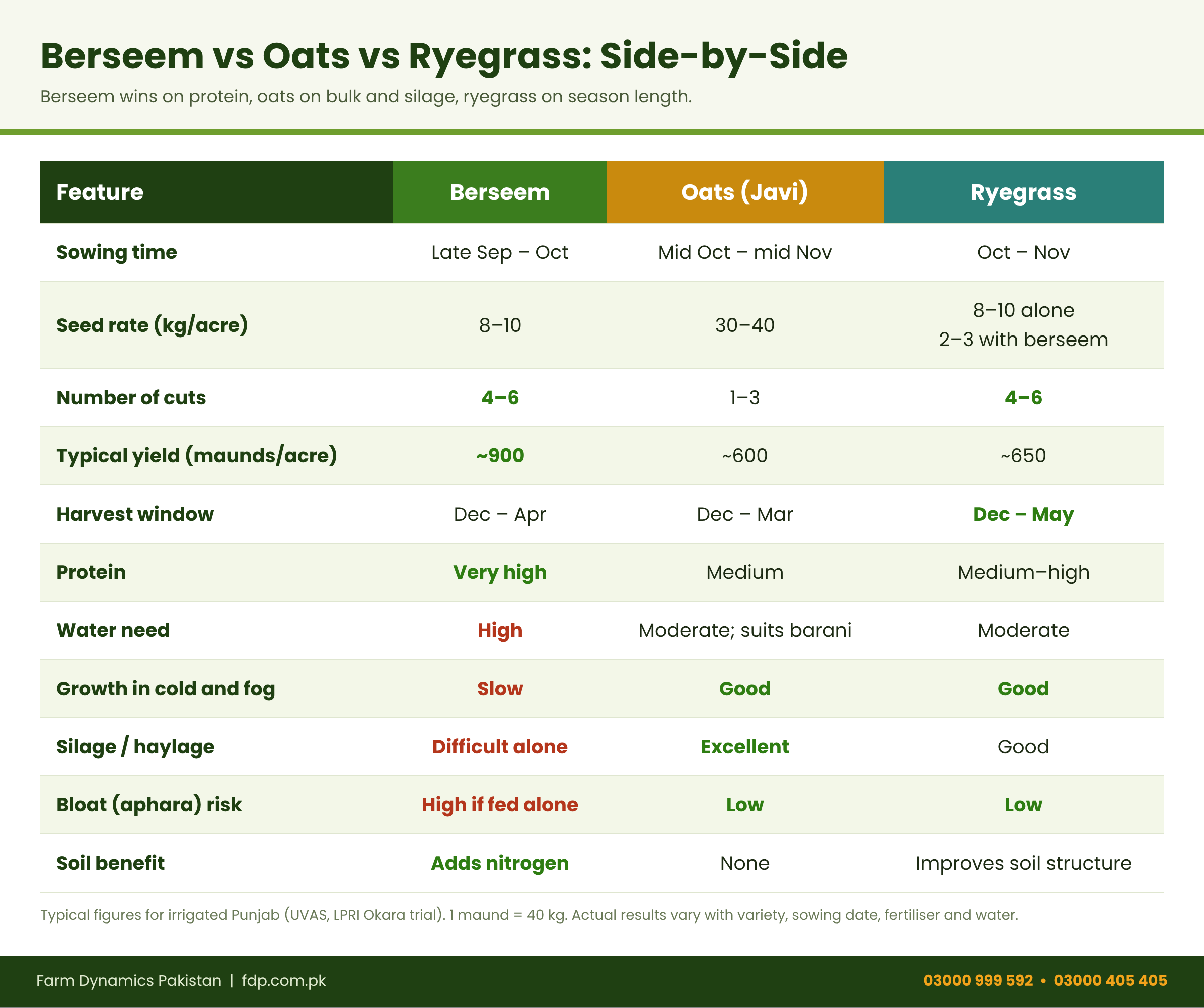
Figures are typical for irrigated Punjab, from UVAS and the Okara trial cited above (1 maund = 40 kg). Actual results depend on variety, sowing date, fertiliser and water.
Which one should you choose?
For most Pakistani dairy farms, the answer is a mixture rather than a single crop. Pick your base crop by your situation:
- Small dairy farmer (5–20 buffaloes or cows) with reliable canal water: berseem plus ryegrass. Berseem supplies protein, and ryegrass adds winter growth and stretches cuts into May.
- Tail-end canal, tubewell-only or barani land: oats or ryegrass rather than berseem, since both need far fewer irrigations.
- Fields vacated late after rice, cotton or sugarcane: oats, which handle late-November sowing best.
- Commercial dairy or feedlot planning silage: oats for bulk silage, with ryegrass for a long green supply and spring haylage.
- Want to cut khal and concentrate costs: berseem plus ryegrass, for protein and digestibility.
- Want to build soil for the next kharif crop: include berseem for its nitrogen.
Proven fodder mixtures
- Berseem + ryegrass: add 2–3 kg ryegrass seed per acre to a full berseem seed rate. This is the most balanced option for most farms.
- Berseem + oats: add oats to berseem for a heavier first cut and lower bloat risk.
- Berseem + oats + ryegrass: about 1 kg ryegrass per acre added to a berseem-oats mixture gives a long season with good quality.
Splitting your fodder area between crops also spreads risk. If frost (pala), a canal closure or water shortage hits one crop, the others keep the herd fed.
Don’t waste the spring surplus: make silage and haylage
From February to April, rabi fodder often grows faster than animals can eat it. Preserving that surplus is the cheapest way to feed the herd through the May–June shortage, instead of buying green fodder at peak prices.
- Oats: cut at milk-to-dough stage and ensile in a pit, bunker or wrapped bales.
- Ryegrass: wilt to about 35–50% dry matter, then bale and wrap as haylage.
- Berseem: too wet to ensile well alone. Mix it with oats or ryegrass, or wilt it before baling.
Good silage depends on keeping air out. Use quality silage wrapping sheets and silage wrapping nets, compact the material well, and seal it quickly. Larger farms can use a round baler and wrapper from FDP to turn surplus fodder into bales that are easy to store, transport or sell.
Get expert advice from Farm Dynamics
Farm Dynamics Pakistan Pvt Ltd has worked with Pakistani dairy and livestock farmers since 2010, including projects to bring quality ryegrass seed to local markets. FDP supplies certified berseem seed and ryegrass seed, silage wrapping materials, hay and haylage machinery, and on-farm guidance. Call 03000 999 592 (Dynamic Seeds) or 03000 405 405, or contact our team to plan the right rabi fodder mix for your farm.
Frequently Asked Questions
Berseem, because of its high protein, especially when balanced with ryegrass or oats.
Yes. Oats and ryegrass both do well when sown in November; berseem sown this late loses cuts.
Not better, but different. Ryegrass keeps growing in the cold and lasts into May; berseem gives more protein. Together they outperform either alone.
Oats, followed by ryegrass. Berseem should be mixed with a grass or wilted first.
Don’t feed it alone or while wet with dew. Mix it with oats, ryegrass or toori.
Share this article
Facebook
Twitter
Linkedin
 7-J1, Main Canal Bank, Johar Town, Lahore.
 Info@farmdynamics.pk


 November 12, 2026