7-J1, Main Canal Bank, Johar Town, Lahore.
  Info@farmdynamics.pk
7-J1, Main Canal Bank, Johar Town, Lahore. Info@farmdynamics.pk


 August 11, 2026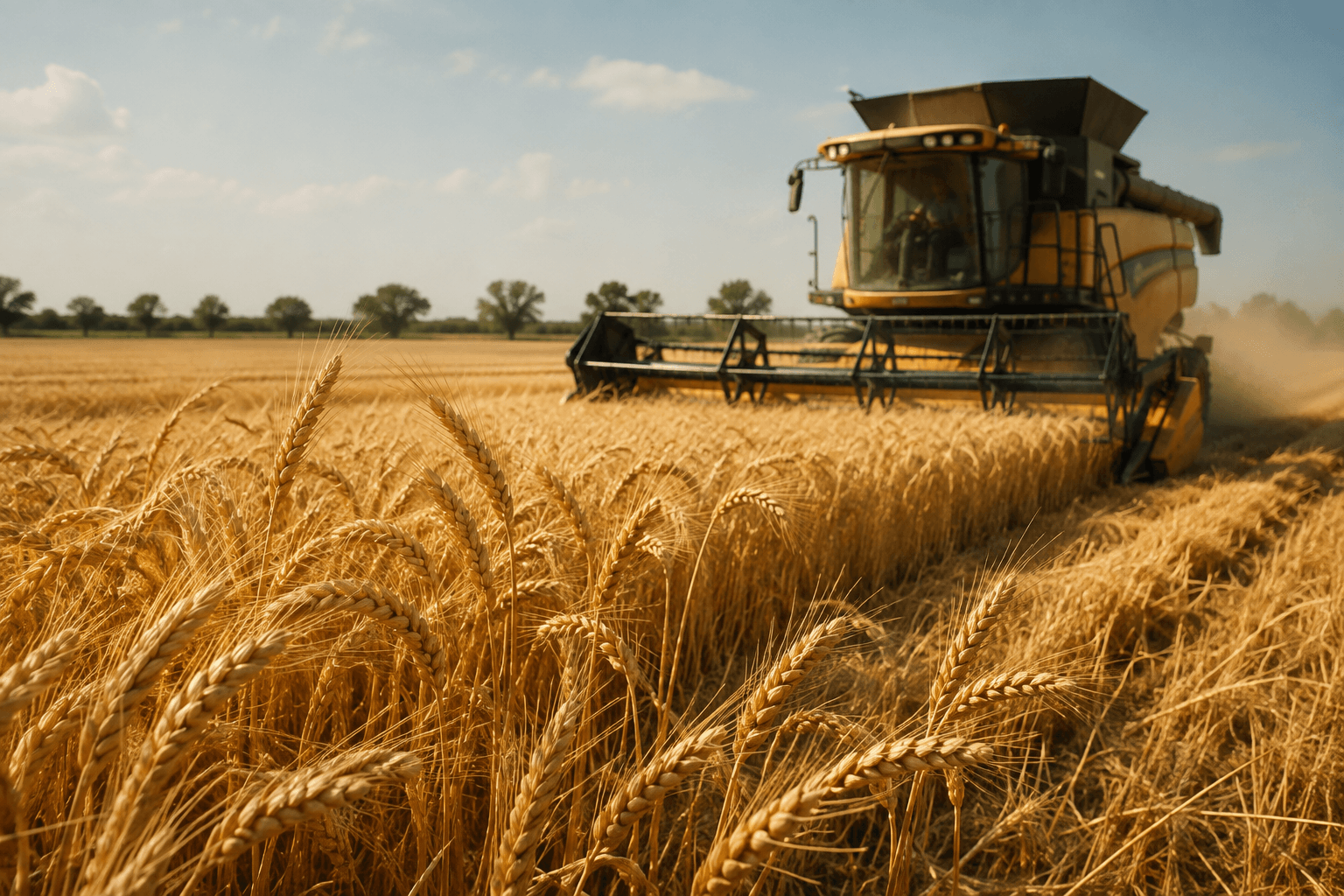
Wheat is one of Pakistan’s most important crops, covering close to 9 million hectares and accounting for roughly 40% of the country’s field-crop area. With national production around 29 million tonnes, getting the harvest right has a major impact on both farmers and the country’s food supply. Yet a significant amount of this crop can be lost after it reaches maturity. Field research in Punjab has reported average harvesting and handling losses of around 10.3%, with losses reaching as high as 16% in some areas. For a farmer harvesting 25 maunds per acre, even a 10% loss means about 2.5 maunds per acre disappearing after the work of growing the crop is already done. The wheat harvesting season in Pakistan generally runs from mid-March to June, but the right harvesting date depends on location, crop maturity, grain moisture, and weather conditions. Harvesting too early, waiting too long, using poorly adjusted machinery, or storing grain at the wrong moisture level can quickly reduce the final amount a farmer gets to sell.
This guide explains when wheat is harvested across Pakistan, how to identify a crop that is ready, the main harvesting methods, ideal grain moisture, ways to reduce harvesting losses, and practical steps for drying, storage, and selling.
The 2026 wheat season is especially important because Pakistan is facing a growing gap between production and consumption. National production is around 29 million tonnes, while consumption for 2026–27 is forecast at more than 31 million tonnes. Government assessments identified a deficit of around 1.2 million tonnes, while the Progressive Flour Millers Group estimated it could reach 2.5 million tonnes.
This supply pressure has also affected prices. Wheat averaged around Rs 4,611 per 40 kg in the first week of July and reached a 29-month price high in early August 2026, compared with the Rs 3,500 per 40 kg procurement rate adopted at harvest time. To help stabilise wheat and flour prices, the federal government approved imports of one million tonnes, although provinces had collectively requested around 2.2 million tonnes. For farmers, these conditions make reducing harvesting and storage losses even more important.
For growers, these conditions make three things particularly important:
Punjab is by far Pakistan’s largest wheat-producing province, accounting for roughly 70% of national production. Industry estimates put Punjab’s 2026 wheat crop at around 19.5 million tonnes out of the national total of approximately 29 million tonnes. Sindh is the second-largest producer and is also the first major region to begin harvesting. Khyber Pakhtunkhwa and Balochistan produce smaller volumes and generally harvest later because of their cooler upland conditions. This regional difference is one reason wheat harvesting does not happen at the same time across Pakistan.
The wheat harvesting season in Pakistan generally runs from mid-March to June. Harvesting begins in the warmer areas of lower Sindh and gradually moves north as temperatures rise, finishing in the uplands of Khyber Pakhtunkhwa and Balochistan.
| Region | Typical Harvest Window |
|---|---|
| Lower Sindh – Thatta, Badin, Hyderabad belt | Mid-March to early April |
| Upper Sindh & Southern Punjab – Sukkur, Rahim Yar Khan, D.G. Khan, Multan | Late March to mid-April |
| Central Punjab – Faisalabad, Sahiwal, Okara, Lahore division | Mid-April to early May |
| Upper Punjab & Pothohar – Gujranwala, Sialkot, Rawalpindi, Chakwal | Late April to late May |
| KP and Balochistan uplands | May into June |
These dates are averages rather than fixed harvesting dates. Sowing date, wheat variety, irrigation availability and March–April temperatures can move an individual field’s harvesting time by around 10 days in either direction. A late-March heatwave can force early maturity and cause shrivelled grain. In contrast, a cool and cloudy spring can extend grain filling and delay harvesting.
Internationally, “winter wheat” usually refers to wheat varieties planted in autumn that require a cold period before flowering. In Europe, North America and China, these varieties are commonly harvested during June and July. Pakistan’s wheat is a Rabi crop, generally planted from October to December and harvested from March to June. It grows through the cooler months like winter wheat, although most Pakistani varieties are spring-type and do not have a strict vernalisation requirement. Therefore, international winter wheat advice may provide useful guidance on moisture and crop maturity, but its harvesting calendar should not be applied directly to Pakistan. Pakistani farmers should work around the country’s March-to-June harvest period.
A few decades ago, harvesting within a Punjab district could stretch across almost two months. Today, that period has become more compressed. Erratic rain and windstorms during March and April make leaving mature wheat standing in the field increasingly risky. At the same time, farmers often want to clear their fields quickly to plant a short Kharif crop such as fodder, mung or sesame. This makes advance planning important. When most farmers in a district require harvesting machinery during the same ten-day period, machine availability falls and hiring rates can rise.
Farmers should not rely on the calendar alone. The condition of the crop provides a much better indication of whether harvesting should begin.
Several visible changes indicate physiological maturity:
Not every kernel within a spike matures simultaneously. Kernels around the middle of the head generally mature first, so farmers should examine several heads from different areas of the field.
Take grains from the middle of several wheat heads across the field. During the hard dough stage, a kernel is firm but can still be dented with a thumbnail. When the kernel can no longer easily be split or dented with a thumbnail, the crop has reached harvest ripeness.
Getting the moisture level right is important for both harvesting and safe storage. Wheat is ideally harvested at around 13–14% moisture. When moisture rises above roughly 14.5%, the risk of mould, bacteria, and insect activity increases. In a previous procurement season, Punjab’s food department even declined to purchase wheat with moisture levels as high as 18%. Harvesting too early can leave farmers with immature grain that requires additional drying, while harvesting too late increases the risk of shattering, birds, rodents, hailstorms, and unexpected rain. Using a digital grain moisture meter can help farmers identify the right harvesting time and confirm that grain is dry enough for storage or sale.
There are four common wheat harvesting methods in Pakistan. The best method depends on farm size, labour availability, livestock requirements, weather risk and the importance of retaining toori.
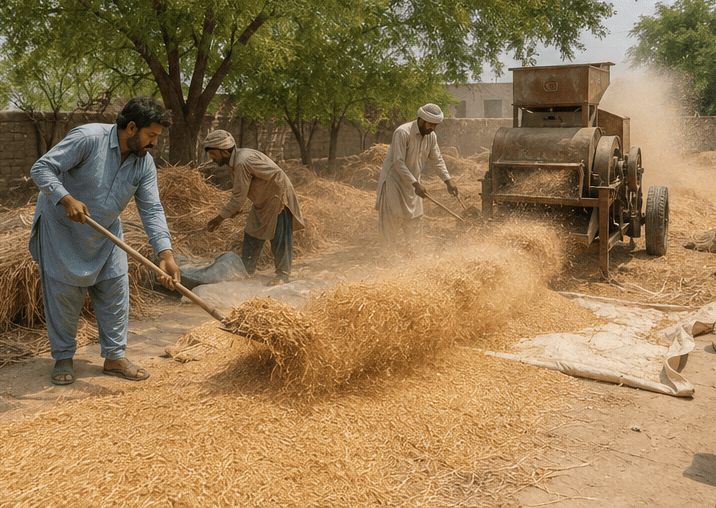
Under the traditional method, workers cut wheat manually using sickles, tie the crop into bundles and leave it in the field for one to three days to reduce moisture. The crop is then processed using a tractor-driven thresher. This method remains useful for many smallholders because it produces high-quality fine toori or chaff, an important livestock feed. However, it requires considerable labour, takes longer and leaves the crop exposed to weather for a greater period.
A tractor-mounted reaper speeds up cutting while workers tie the cut wheat into bundles before feeding it into a thresher. It provides faster harvesting than completely manual cutting while still producing useful chaff. Its main limitation is lodged or flattened wheat. Reapers cannot effectively lift a lodged crop, which becomes particularly important following untimely March and April rain or windstorms.
Do You Know? Thresher sales have also fallen by roughly half over four years, while threshers now cost around Rs 0.8–1 million.
A reaper-cum-binder cuts and binds wheat during the same pass. It further reduces harvesting time compared with traditional rope made from rice straw.
A combine harvester performs several operations in a single pass. It cuts the wheat, threshes it, cleans the grain and collects it. The machine also clears the field quickly, allowing farmers to prepare for the next crop.
Do You Know? Use of Combine Harvesters has increased considerably. Reaper production in the Daska manufacturing cluster has fallen from more than 15,000 units annually a decade ago to barely 3,000 in 2026.
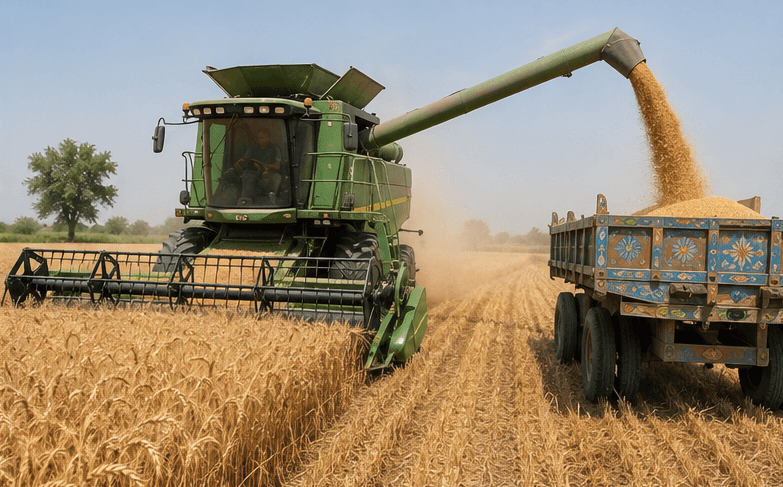
Pakistan does not manufacture combines domestically, and imported machines dating back to the 1970s and 1980s are still operating in some fields. Older and poorly adjusted machines can result in substantial grain losses. The supplied research associates these ageing, poorly adjusted machines with loss figures reaching 16%. Farmers comparing combine harvester price in Pakistan or contractor rates should therefore consider machine condition as well as price. A cheaper but poorly maintained combine may lose enough grain to cancel out the saving on the hiring rate.
Newer locally modified combines are also addressing the traditional chaff problem. Machines fitted with choppers and D-shaped chaff tanks have become more common over the past two seasons, allowing farmers to collect grain and toori during the same operation rather than scattering straw across the field.
| Method | Best Suited To | Key Advantage | Key Drawback |
|---|---|---|---|
| Manual + thresher | Smallholders with family labour and livestock | Best-quality fine toori | Slow, labour intensive and greater weather exposure |
| Reaper + thresher | Small to medium farms | Faster cutting and good chaff | Cannot effectively handle lodged crops |
| Reaper-cum-binder | Medium farms wanting speed with chaff | Cuts and binds in one pass | Binding thread costs around Rs 2,500/acre |
| Combine harvester | Medium to large farms, tight harvest windows and lodged crops | Single-pass operation and immediate field clearance | Higher cost; older machines may lose more grain |
| Combine + chopper/D-tank | Farmers wanting grain and toori quickly | Grain and chaff in one operation; reduces need for residue burning | Quality of local modifications varies |
Successful harvesting starts several weeks before the combine, reaper or labour crew enters the field.
Preparation should begin well before the wheat is ready to harvest. This period gives farmers enough time to prepare the field, arrange machinery and labour, and make sure storage is ready before the busy harvesting window begins.
During the final week, attention should shift from general preparation to the actual condition of the crop. Moisture levels, weather forecasts, field access, and market rates can all influence when harvesting should begin.
Harvest day is where proper preparation starts paying off. The main focus should be harvesting at the right moisture level while keeping machine-related grain losses as low as possible.
Once wheat has been cut, careful handling becomes essential. Prompt threshing, proper cleaning, and controlled drying help maintain grain quality and prepare the crop for safe storage.
Proper storage is just as important as timely harvesting. Only clean, dry, and cool grain should enter storage, as poor storage conditions can lead to insects, mould, and further grain losses.
Storage insect losses in Pakistan have been estimated at 10–18% of stored grain in affected lots. Khapra beetle larvae can survive for years without food and hide in cracks, making proper cleaning and sanitising before storage essential. Inspect stored wheat weekly during the first month and monthly afterward. Warm spots or a musty smell may indicate moisture or mould and require immediate attention.
Safety Note: Never fumigate near living areas. Phosphine and similar fumigants are lethal to humans. If fumigation is required, use a licensed applicator.
Wheat harvesting does not end once the grain leaves the field. The remaining straw and toori still have value and, when managed properly, can support livestock, improve soil management, or provide an additional source of farm income. Instead of treating wheat residue as waste, farmers have several practical ways to use it.
Toori is widely used as livestock feed and can be particularly valuable for farmers who keep cattle. Farmers without livestock can also supply it to nearby dairy farms, turning a harvesting by-product into an additional source of income.
Wheat straw left after harvesting can be collected and managed with straw choppers, forage harvesters, and balers. Baling makes the residue easier to handle, transport, and store for later use. Farmers already comparing silage baler machine price in Pakistan for their fodder operations can consider machinery that can also handle wheat straw. Using the same equipment across different crops and seasons can increase its overall usefulness on the farm.
Not all wheat residue needs to leave the field. Remaining material can be incorporated into the soil or left as mulch. This provides farmers with another option for managing residue without burning it.
Burning may appear to be a quick way to clear the field, but it destroys organic matter, damages soil biology, contributes to poor air quality, and increasingly attracts penalties. Where suitable machinery and residue-management options are available, burning should not be the default choice.
Timely residue management also helps farmers move into the next cropping cycle sooner. Once straw and toori have been collected, chopped, baled, or incorporated into the soil, the field can be prepared for the next crop.
A farmer’s final return from wheat is not determined by yield alone. A crop can perform well throughout the growing season and still lose a significant share of its value during harvesting, drying, handling or storage. The difference between a 3% loss and a 15% loss is not simply the size or price of the harvesting machine. Correct timing, a moisture meter, properly booked and adjusted machinery, slower combine speeds where necessary, clean storage and careful handling can all help protect the grain that has already been produced. For Pakistani farmers, preparing for harvest before the crop reaches maturity is therefore just as important as managing the crop while it is growing. The objective is simple: harvest at the right time, lose as little grain as possible, store it safely and protect its value until it is sold.
Farm Dynamics Pakistan (FDP) supplies agricultural machinery, harvesting equipment and farm solutions to growers across Pakistan. Whether farmers are comparing harvester machine options for the coming Rabi season, sourcing spare parts before peak demand, or planning residue and fodder equipment, the right machinery should be selected according to farm size, crop conditions and the harvesting plan.
Wheat is harvested from mid-March to June. Harvesting starts in lower Sindh around mid-March, moves through southern and central Punjab during April, reaches upper Punjab and Pothohar during late April and May, and finishes in the uplands of KP and Balochistan during May and June.
Four common methods are used: manual cutting with a sickle followed by tractor threshing, tractor-mounted reapers with threshers, reaper-cum-binders, and combine harvesters. A combine performs cutting, threshing, cleaning and grain collection in one pass.
International winter wheat is generally harvested in June and July. Pakistan’s wheat is a Rabi crop planted from October to December and harvested from March to June.
Punjab produces roughly 70% of Pakistan’s wheat, with an estimated 19.5 million tonnes in 2026 out of a national crop of approximately 29 million tonnes. Sindh is the second-largest producer, followed by Khyber Pakhtunkhwa and Balochistan.
Yes. For the 2026–27 marketing year, consumption is expected to exceed production. Government estimates initially put the deficit at around 1.2 million tonnes, while flour-miller estimates have placed it as high as 2.5 million tonnes. Wheat prices reached a 29-month high in early August 2026.
Yes. The federal government approved imports of one million tonnes of wheat in 2026 after requests from provincial governments. Provinces had collectively requested approximately 2.2 million tonnes.
The workable range is around 20% to 13%, with 13–14% considered ideal for harvesting. For long-term storage, grain should be dried to approximately 12–12.5%. Above roughly 14.5%, the risk of mould and insect activity increases.