7-J1, Main Canal Bank, Johar Town, Lahore.
 Info@farmdynamics.pk
7-J1, Main Canal Bank, Johar Town, Lahore. Info@farmdynamics.pk


 November 24, 2026
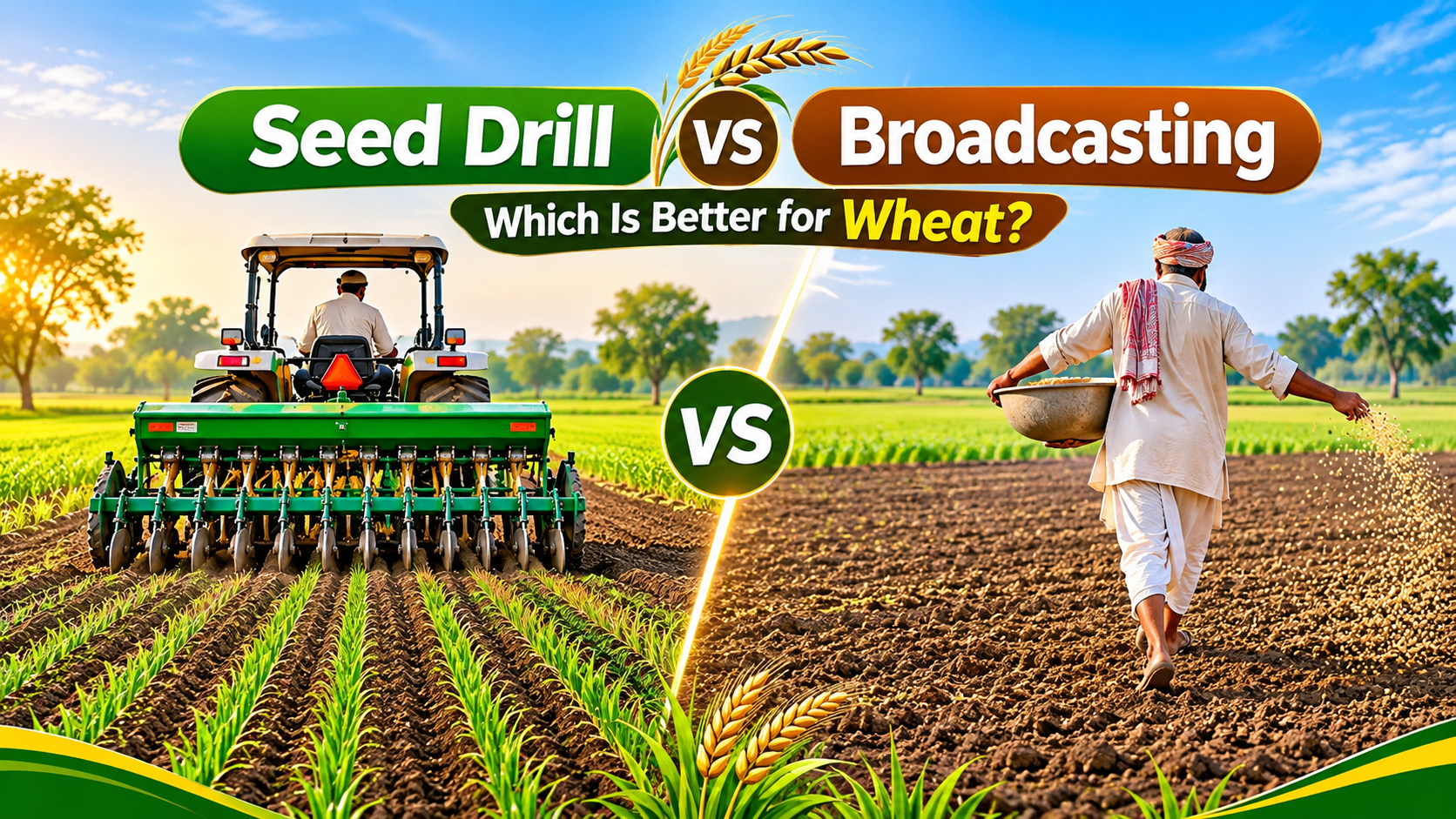
For most Pakistani farms, a wheat seed drill is the better choice. It places seed at a uniform depth and spacing, which improves germination, saves seed and makes weeding, irrigation and harvesting easier. Broadcasting is cheaper to start with and fast on small plots, but it wastes seed and gives an uneven crop. The gap matters most in late sowing, when every day counts.
In short: if you farm more than a few acres, sow wheat after sugarcane or cotton, or want a uniform crop that is easy to manage, choose a drill. If your plot is very small or irregular and no machine is available, broadcast carefully and prepare the seedbed well. The rest of this guide explains the reasons and shows how to get the most from either method.
Wheat is sown once, and mistakes made on sowing day stay with the crop until harvest. Uneven depth means uneven emergence. Uneven emergence means some plants shade others, compete for water and ripen at different times. The sowing method is therefore not a small detail. It sets the plant stand, and the plant stand sets the yield potential.
With the Punjab Agriculture Department urging farmers to complete irrigated wheat sowing by around 20 November, many farmers are choosing between speed and quality right now. Understanding both methods helps you decide without guessing.
Sowing method also interacts with other decisions. A uniform stand makes fertilizer timing, irrigation scheduling and weed control more predictable. A patchy stand forces compromises: thin areas need different care from thick ones, and one field ends up with several crop stages at once. Choosing the method early, before you book labor, seed and machinery, saves both money and stress during the busy sowing weeks.
In broadcast sowing, seed is scattered by hand or with a simple spreader and then covered by ploughing or planking. It needs very little equipment, which is why it is still common.
The problems are practical:
Broadcasting also depends heavily on the person doing it. Two workers can scatter the same quantity of seed and get very different stands, because throwing distance, walking speed and wind all change the spread. Covering is the second weak point: if ploughing or planking after scattering is too shallow, seed stays exposed, and if it is too deep, emergence suffers. These variables are hard to control, which is why results from broadcasting vary more from farm to farm than results from a calibrated drill.
Broadcast wheat is also more sensitive to weather right after sowing. A dry spell leaves shallow seed without moisture, while heavy rain can wash or bury seed unevenly. A drill reduces this risk by placing seed in a furrow with soil cover around it.
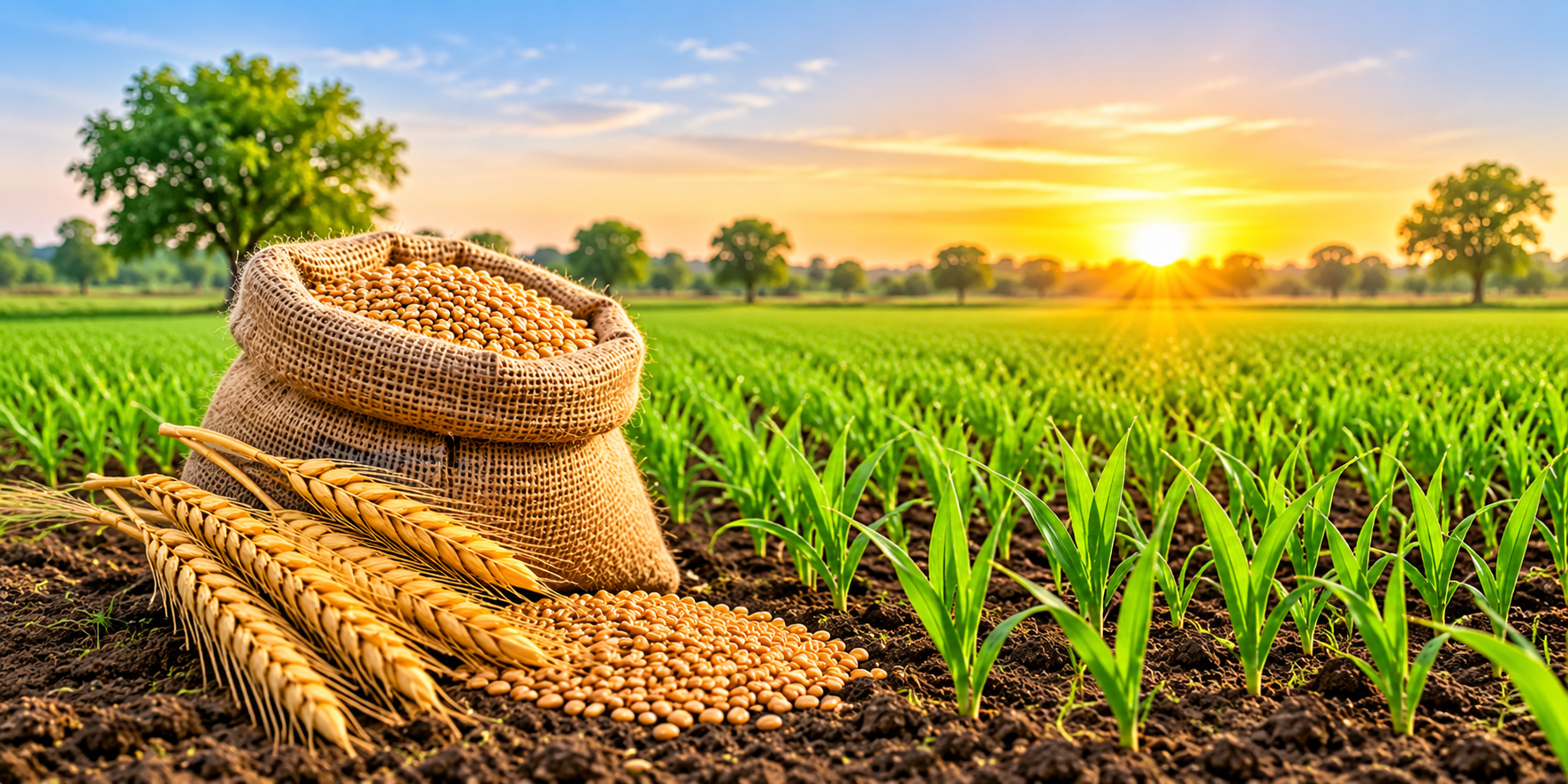
A seed drill opens a furrow, drops seed at a set rate, covers it and in many models applies fertilizer at the same time. Because seed goes in rows at a controlled depth, the field emerges evenly.
The main advantages are:
Drills come in several types. Conventional drills work on a prepared seedbed, while zero-till and happy-seeder style machines can sow directly into residue or unploughed soil, which can save further time and fuel. Combined drills that also place fertilizer put nutrients close to the seed row, where young roots can reach them. The right type depends on your soil, your previous crop and the tractor you own, so compare options before buying or hiring.
Another benefit is consistency across seasons. Once a drill is calibrated and you know the settings that suit your soil and variety, you can repeat them every year. Broadcasting offers no such repeatability, because each season depends on who is scattering and how.
Broadcasting normally needs a higher seed rate than drilling, because part of the seed is lost to birds, shallow drying and poor coverage. Many agronomists report meaningful seed savings with drills, but the exact figure depends on the variety, seed size and soil. Follow the seed rate recommended by the Punjab Agriculture Department or your local extension office for your variety and sowing date, and calibrate your drill before starting.
On cost, a drill is a larger upfront investment than a hand spreader. For farmers with small holdings, hiring a drill through a service provider can be the practical route. For farmers with larger areas, ownership can pay back through seed savings, better stands and lower labor use over several seasons. It is wise to work out your own numbers using your acreage and local seed prices.
A simple way to compare the two is to list your own costs for one season: seed quantity and price, labor for sowing and covering, tractor time and fuel, and either drill hire charges or the yearly share of drill ownership. Then add the benefits that are harder to price, such as a more even crop and easier weed control. Keep records for a season or two, and your next decision will rest on your own farm data rather than on general advice.
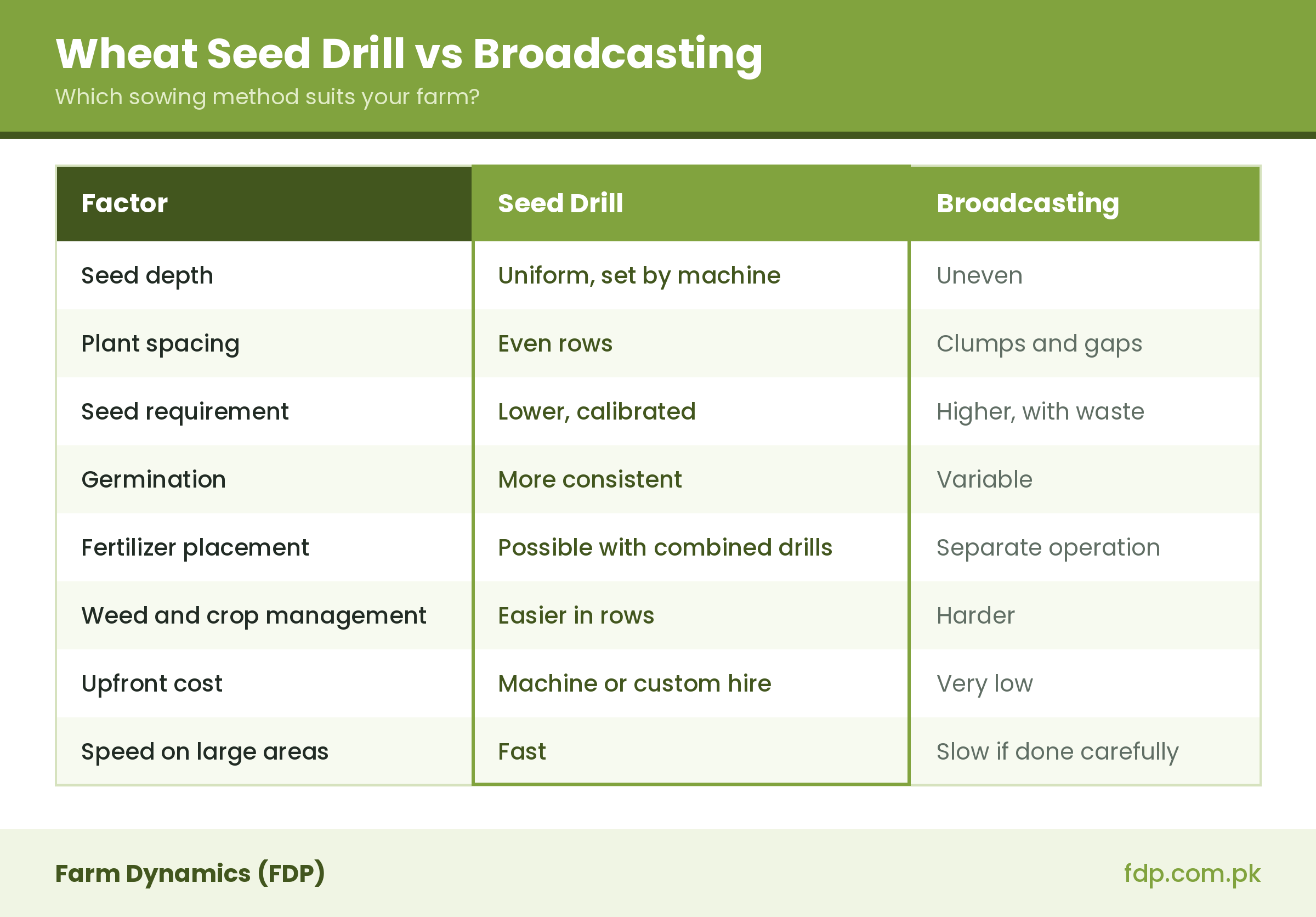
The table shows a clear pattern. Broadcasting wins only on upfront cost. On almost every factor that affects the crop itself, such as depth, spacing, germination and manageability, the drill performs better. The real question for most farmers is therefore not whether a drill is better, but whether they can access one in time through ownership or hiring.
Broadcasting has limited but real uses. It can suit very small plots, patchy or irregular fields, or situations where no machine is available. Even then, results improve when the seedbed is well prepared, seed is covered evenly and the field is planked afterwards. If you must broadcast, treat the seed, avoid sowing into dry soil and irrigate on time.
If you broadcast, a few habits improve the result. Split the seed into two lots and cover the field in two passes at right angles, so the spread is more even. Sow on a calm day, since wind carries seed unevenly. Cover the seed lightly and plank the field immediately to firm the soil around it. Finally, check the field about two weeks after sowing and note thin patches, so you can plan inputs and, where needed, gap-filling.
To explore sowing equipment, visit FDP’s Planting machinery page.
Pre-season checklist. Before the sowing rush, confirm that the drill is in working order, spare parts are available, seed is certified and treated, fertilizer is arranged, and the tractor is serviced. A single breakdown in the middle of November can cost several days, and each day of delay can reduce wheat yield potential. Planning a week ahead removes most of this risk.
After sowing. Walk the field about 10 to 15 days after sowing to check emergence. Look for blocked tubes, skipped rows or uneven depth. Catching a drill fault early lets you correct it on the remaining area and note it for next season.
Farmers with medium to large holdings, farmers sowing wheat after sugarcane or cotton with limited turnaround time, and farmers who want a more uniform crop all benefit most. Late sowing makes the case stronger, because a drill saves time and gives the shorter-season crop its best chance at a good stand.
Smaller farmers are not left out. Group purchase, farmer associations and local service providers make drills accessible without a large investment. If you hire, agree on the sowing date, seed rate and depth in advance, and be present during the first few passes to confirm that the settings match your plan.
Drill sowing beats broadcasting on germination, seed use, crop uniformity and ease of management. Broadcasting still has a place on very small or irregular plots, but for most farmers the drill is the more reliable way to protect yield. Whatever method you use, prepare the seedbed well, use treated certified seed and irrigate on time.
Before this season’s sowing is finished, decide your method, confirm machinery availability and calibrate your equipment. A few hours of preparation can protect the whole crop. To see sowing and field preparation options, browse FDP’s Planting, Land Preparation and Tractors pages.
In most cases, yes. A drill gives uniform depth and spacing, better germination and more efficient seed use.
Around 4 to 5 cm is generally recommended, though soil type and moisture can change this slightly.
Usually yes, because seed is placed accurately and less is lost. Follow the locally recommended rate for your variety and sowing date.
Yes. Custom hiring is common and suits small and medium farms. Book early, since demand is high in November.
Yes. It saves time and improves the stand, which helps late-sown wheat make better use of its shorter growing period.
For irrigated areas, the recommended window is roughly 1 to 20 November. Check your local Agriculture Extension office for the date that suits your district and variety.
Indirectly, yes. Row sowing makes it easier to apply herbicides and carry out weeding operations, and a uniform dense stand competes better against weeds.
Many drills can be adjusted for other seeds, but settings, plates and seed rates differ. Check the manual and recalibrate for each crop.