7-J1, Main Canal Bank, Johar Town, Lahore.
  Info@farmdynamics.pk
7-J1, Main Canal Bank, Johar Town, Lahore. Info@farmdynamics.pk


 August 13, 2026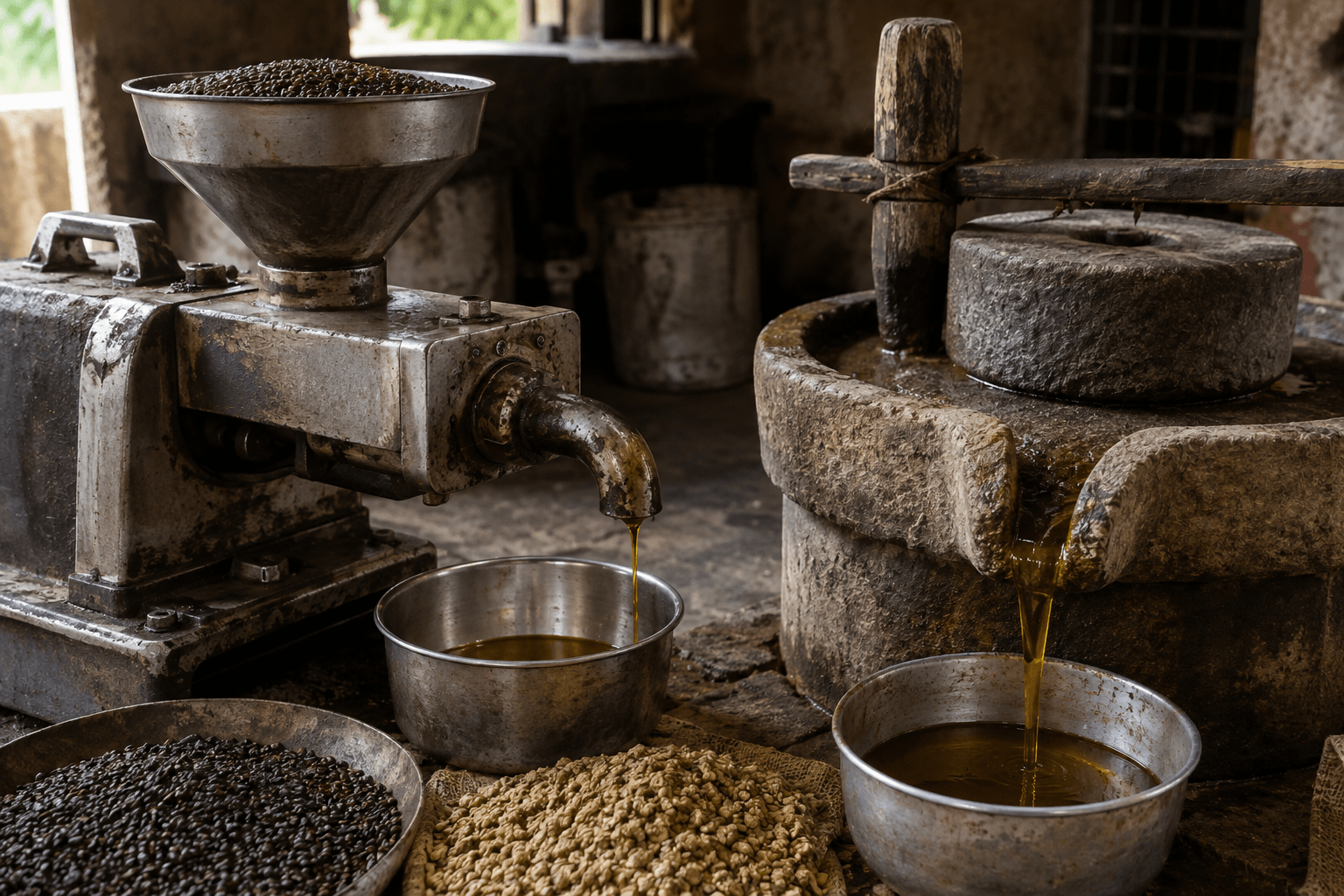
Oil extraction has been part of agriculture for generations. Farmers grow oilseed crops such as mustard, sunflower, sesame, groundnut, and canola, but harvesting the seed is only the first part of the process. The method used to extract oil can affect processing time, oil quality, production capacity, operating requirements, and what happens to the material left after extraction. A cold press oil machine uses mechanical pressure to extract oil while limiting the amount of heat generated during processing. Traditional oil extraction is a broader term and can include older mechanical presses, traditional ghani or kolhu systems, expellers that generate more heat through friction, and industrial extraction methods. For farmers and agricultural businesses considering value-added processing, understanding these differences is useful even before machinery is considered. This guide compares cold pressing with traditional oil extraction, explains where each method fits, and looks at the factors that determine which approach may be more practical.
A cold press oil machine mechanically presses oil-bearing seeds to separate oil from the solid material. Unlike extraction processes that intentionally depend on high temperatures, cold pressing aims to keep processing temperatures relatively low. The basic process is straightforward. Seeds are cleaned and prepared before entering the press. Mechanical pressure crushes and compresses the material, causing oil to separate from the seed solids. The extracted oil is collected while the remaining solid material leaves the machine as press cake. However, “cold pressed” should not be understood as meaning that absolutely no heat is produced. Mechanical pressure and friction naturally generate some heat. The main difference is that the process is designed to avoid the higher temperatures associated with many conventional extraction systems.
Cold pressing is often associated with smaller processing units, specialty oils, farm-level value addition, and businesses where oil characteristics are more important than extracting the maximum possible quantity from every kilogram of seed.
Traditional oil extraction covers several methods rather than one single process. In Pakistan and other agricultural regions, oil has historically been extracted using mechanical systems such as ghani or kolhu presses. Modern conventional processing may use mechanical expellers, heating, or larger industrial extraction systems.
A ghani or kolhu crushes oilseeds through slow mechanical pressure. Traditional systems were operated using animals, although motor-powered versions are also used. These systems have cultural and local-market importance, but production capacity can be limited compared with modern continuous machinery.
An expeller continuously pushes oilseeds through a chamber using a rotating screw. Pressure and friction separate the oil from the solid material. Because friction generates heat, operating temperatures can be higher than in systems specifically designed for cold pressing. Expellers are widely suited to situations where continuous processing and greater throughput are priorities.
Large processing facilities may use several stages, including seed preparation, heating, mechanical pressing, filtration, refining, or solvent-based extraction. These operations are designed around high throughput and efficient oil recovery. Their infrastructure, technical requirements, safety considerations, and investment levels are very different from those of a small farm or local processing unit.
Neither approach is automatically better for every situation. The right method depends on the oilseed, required production volume, target market, available investment, and desired characteristics of the final oil.
| Factor | Cold Press Oil Machine | Traditional/Conventional Extraction |
|---|---|---|
| Extraction process | Mechanical pressing with limited heat | May involve mechanical pressure, friction, heating, or further processing |
| Production scale | Often small to medium | Can range from traditional small units to industrial plants |
| Oil recovery | May leave more oil in the press cake | Some conventional methods aim for higher oil recovery |
| Processing | Generally simpler | Can involve several processing stages |
| Oil characteristics | Often chosen where less processing is preferred | May undergo additional treatment or refining |
| Equipment needs | Can suit smaller processing operations | Requirements vary greatly by extraction method |
| Throughput | Depends on machine capacity and seed | Industrial systems can process large volumes |
| Best fit | Specialty, local or farm-level processing | Larger-volume or conventional production |
Not necessarily. This is one of the most important differences to understand. A cold press oil machine may leave a greater amount of residual oil in the press cake compared with extraction systems designed to maximize oil recovery. Conventional industrial processes can use additional pressure, heat, or further extraction stages to recover more oil from the same quantity of raw material. However, oil recovery alone does not determine whether an operation is profitable. A farmer or processor also needs to consider the selling price of the final oil, cost of seed, electricity, labour, packaging, filtration, storage, machine capacity, maintenance, and potential value of the press cake. For a business selling a differentiated cold-pressed product, a lower extraction rate may still make commercial sense. For a high-volume processor competing mainly on production cost, maximum oil recovery may be more important.
Processing conditions can influence the characteristics of extracted oil. Cold pressing is generally used when the processor wants to limit intensive heat treatment and preserve more of the oil’s natural characteristics. Conventional processing may involve higher temperatures or additional refining depending on the method and intended product. These extra stages can help create a more standardised product and may improve processing efficiency, but the final oil will differ from minimally processed cold-pressed oil. Quality also depends heavily on the raw seed itself. A sophisticated machine cannot compensate for badly stored, mouldy, contaminated, or poor-quality oilseeds. Seed variety, maturity, moisture, cleanliness, storage conditions, and time between harvest and processing can all influence the final result.
The suitability of an oilseed depends on its oil content, physical properties, moisture level, preparation requirements, and the specifications of the machine being used. Common oil-bearing crops include:
This creates an interesting connection between crop production and post-harvest processing. Instead of selling the entire harvest as raw seed, some growers or agricultural businesses may consider processing part of their production into oil. That does not mean every oilseed farmer should start processing. Market demand, processing costs, food regulations, packaging, storage, and access to customers all need to be considered first.
The extraction process begins before seeds reach the press. Foreign material such as stones, soil, stalks, dust, and damaged seeds should be removed. Poorly cleaned material can affect processing and may also increase wear on equipment. Moisture also matters. Seed that is too wet or too dry may behave differently during pressing and can affect oil recovery and processing performance. The correct preparation depends on the particular seed and extraction system. Storage is equally important. Oilseeds should be protected from excess moisture, pests, contamination, and conditions that can reduce quality before processing. This is why oil extraction should be viewed as part of the wider post-harvest system rather than as a single machine operation.
Modern farming increasingly involves more than producing and selling raw crops. Processing can allow agricultural businesses to move further along the value chain. For example, a farmer may traditionally grow sunflower or mustard and sell the harvested seed. With suitable processing facilities and a viable market, an agricultural business could instead clean the seed, extract the oil, package it, and sell a finished or semi-finished product. This is known as value addition. The same principle can be seen elsewhere in agriculture. Fodder can be converted into silage or alfalfa hay, grain can be cleaned and dried before sale, and crop residues can be baled rather than treated as waste. Agricultural processing allows the value of a crop to extend beyond the field.
This wider shift is also increasing interest in specialized agriculture equipment that handles crops after harvesting.
It can be, but only under the right circumstances. Buying processing equipment simply because a crop is available is not enough. Before investing, a farmer or agricultural business should calculate whether there is enough raw material and market demand to keep the equipment economically productive.
How much mustard, sunflower, sesame, canola, or another suitable oilseed will be available each season? A machine that is significantly larger than the available seed supply may remain idle for much of the year.
The processor needs customers for the oil. This could include direct consumers, retailers, wholesalers, food businesses, or other processors depending on the operation. Producing oil without first understanding where it will be sold creates unnecessary risk.
Machine price is only one cost. Businesses should also consider:
The expected value of both the oil and remaining press cake should then be compared with these costs.
Oil is not the only material produced during mechanical extraction. Once the oil has been pressed out, a solid seed cake remains. The possible use and value of this material depend on the oilseed and how it has been processed. In appropriate cases, oilseed cakes may have applications in animal feeding, organic matter management, or further processing. Their suitability should always be determined for the specific seed and intended use rather than assuming that every press cake can be used in the same way. For agricultural businesses, this matters because a by-product that has a useful market can improve the economics of the overall processing operation. It follows the same principle seen throughout agriculture farming: making better use of what is produced can reduce waste and create additional value.
Cold pressing can offer several practical benefits where the production model suits the technology.
These benefits should still be weighed against extraction efficiency, operating costs, available seed supply, and market demand.
Cold pressing also has practical limitations. The most obvious is that it may not recover as much oil as extraction methods designed for maximum recovery. This can leave more residual oil in the press cake. Production capacity may also be lower than large conventional plants. For processors handling very large quantities of oilseed, throughput becomes a major consideration. Another challenge is consistency. Seed moisture, variety, cleanliness, storage, and machine settings can all affect processing performance. Operators therefore need to understand both the crop and the equipment. Finally, extracting oil does not automatically create a successful business. Food safety, filtration, packaging, storage, labelling, distribution, and market demand remain important after the pressing process is complete.
There is no single answer because the two approaches serve different needs. A cold press oil machine may make more sense for a farmer, cooperative, or small processor interested in lower-temperature mechanical extraction, specialty oil production, and agricultural value addition. Traditional or conventional extraction can be more suitable where higher throughput, greater oil recovery, or large-scale standardized production is the priority. Before choosing an extraction method, consider four questions:
Answering these questions is more useful than selecting a machine based only on capacity or price.
The choice between a cold press oil machine and traditional oil extraction methods is ultimately a question of purpose. Cold pressing can provide a practical route into value-added oil production, particularly where farmers or small processors have suitable oilseeds and a market for differentiated products. Conventional extraction, meanwhile, remains important where production volume and maximum oil recovery are the main priorities. For farmers, the most important lesson is to look beyond the machine itself. Seed supply, crop quality, processing capacity, operating costs, by-product value, storage, and customer demand all determine whether oil extraction makes economic sense.
Farm Dynamics Pakistan shares practical information on modern farming, agriculture equipment, crop production, harvesting, and agricultural mechanization to help growers and industry professionals better understand the technologies shaping Pakistan’s agricultural secto
A cold press oil machine mechanically presses oil-bearing seeds to separate oil from the solid seed material while limiting the high-temperature processing associated with some conventional extraction methods.
It can be suitable for farmers or agricultural businesses that have access to enough oilseed, a market for the processed oil, and the resources required for processing, filtration, packaging, storage, and distribution.
Cold pressing focuses on mechanical extraction while limiting heat. Traditional extraction can include ghani or kolhu systems, mechanical expellers, and larger conventional processes that may use more heat or additional extraction stages.
No extraction method necessarily removes every drop of oil. Cold pressing may leave more residual oil in the press cake than processes specifically designed to maximise oil recovery.
It depends on the business. Smaller or specialty processors may prefer cold pressing, while large-volume processors may prioritise conventional systems offering greater throughput and oil recovery.